
.svg)
.svg)
.svg)
What MedTech Hiring Managers Notice First
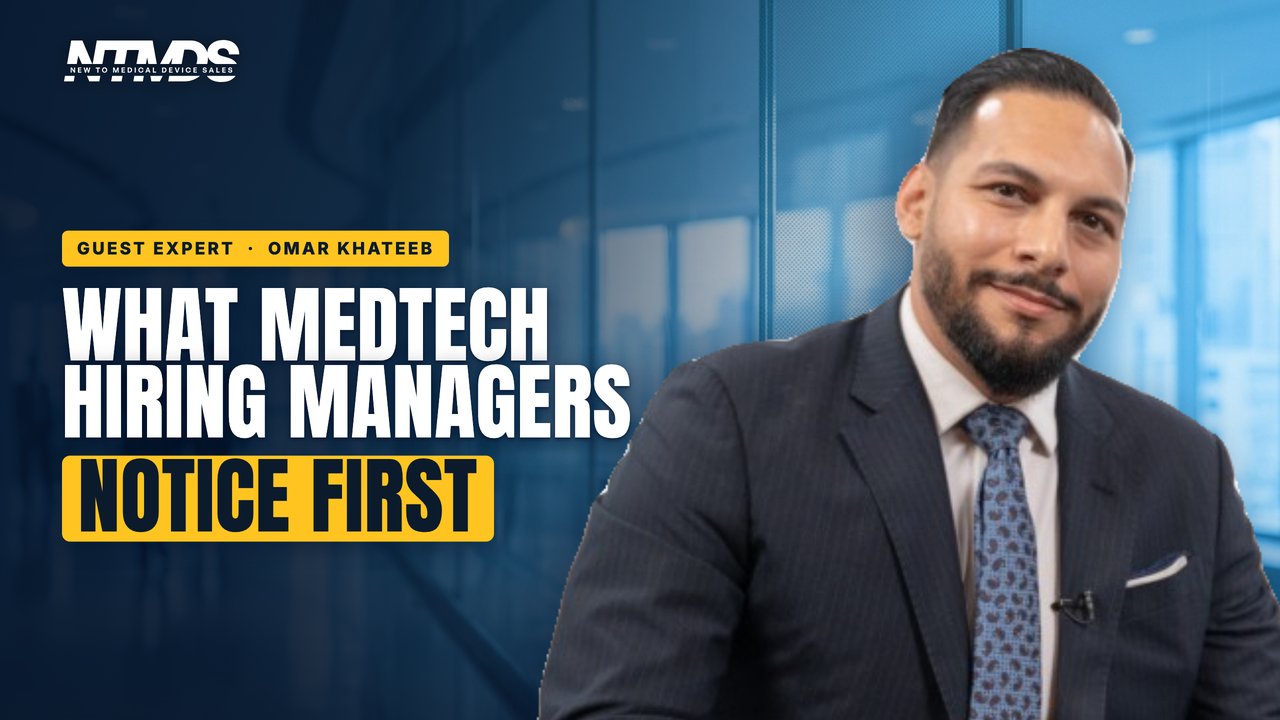
What MedTech Hiring Managers Notice First
The first thing medtech hiring managers notice is how you run the interview. That's because the interview is your first sales call. Before anyone reads your resume, they've watched how you prepared, how you carry yourself, and how you handle a hard question. Medical device sales means selling to surgeons under pressure. So a hiring manager treats your interview as a live demo of the rep you'll be in the room. Everything else confirms a read they started forming in the first few minutes.
Key Takeaways
- Hiring managers judge how you run the interview before they weigh your resume, because the conversation is a live demo of a medtech sales call.
- The strongest candidates walk in having researched the product, the procedures it's used in, and the competitors. They didn't stop at the comp plan.
- Presence is a signal. If you stay calm and credible answering a curveball, you can stand next to a surgeon.
- Wanting real work beats wanting the title. Reps who can only talk about the paycheck get noticed for the wrong reasons.
- You don't need a clinical background to break in. I left medical school and started as a rep carrying the bag at Mazor Robotics.
- Coachability is the trait every hiring manager is scanning for, because the entire first year is training.
The interview is your first sales call
When I was a clinical sales rep at Mazor Robotics, the world's first robotic spine company, I didn't have a medical degree. I'd left medical school halfway through. What I had was a realization that got me the job: the interview was the sales call, and I was the product.
Most people walk into a medtech sales interview trying to explain why they'd be good at the job. The candidates who get hired do something different. They run the conversation the way they'd run a real call with a surgeon:
- Build rapport early.
- Ask questions before they pitch.
- Treat hard moments like objections instead of freezing.
- Ask for the job at the end.
That last part matters more than people think. I've done the hiring, and the number of candidates who never close is staggering. They spend forty minutes proving they're qualified, then wait to be picked. If you can't ask me for the role to my face, I won't believe you'll ask a hospital to switch to your device.
You can hear this instinct in how reps who break in talk about their interviews. In New To Medical Device Sales' roundup of honest advice from working reps, one recalled the moment an interviewer asked the classic question:
"He says, 'Why should I hire you?' My answer was, I think the better question is: what would happen if you didn't hire me? I'm going to go work for your competitor, because I'm going to get into medical devices. He paused, he was silent, and I thought, oh God, I just ruined this interview. And he said, "That is the best answer I've ever heard for that question."
That is conviction, and it is the same energy that moves a surgeon who is on the fence. Hiring managers are watching for it in the room.
So before you worry about your answers, look at the shape of the conversation. A good medical device sales interview should feel like a good sales call: warm, prepared, specific, and closed.
What I notice in the first ten minutes
Long before I reach your resume, I've clocked whether you did the homework.
I'll ask what you know about our product. If you can name the procedure, the surgeons who adopt it first, and who we compete against, you've separated yourself from the field already. You showed me you'll do that same work for every account I hand you. Medtech sales is a research job before it's a talking job.
The second thing I notice is presence. Can you hold eye contact and stay composed when I push back? Medical device sales happen in operating rooms, next to surgeons who are demanding by design and short on patience. If a curveball in a calm interview rattles you, I'll wonder what happens when a surgeon challenges you mid-case. Nobody expects you to know everything. They expect you to stay steady while you don't.
You don't need experience in medical device sales jobs to do any of this. Treat the conversation like it's already the job.
Show me you understand the work you're signing up for
The highlight reel leaves this part out.
Breaking into medical device sales means 5am hospital arrivals and cases that run long. It means being on call when you'd rather not be, and carrying heavy equipment through a parking garage before the sun is up. The comp can be excellent. The lifestyle, especially early, is not glamorous. When I'm hiring, I'm listening for whether you want that work. Or whether you just want the paycheck and the title on the business card.
The candidates who stand out talk about wanting to be in the room. They're curious about the anatomy, the procedure, and the reason the device exists. And the strongest ones have often started before anyone paid them to. They've done ride-alongs. They've put themselves through medical device sales training on their own.
Jacob McLaughlin, who founded New To Medical Device Sales, makes the same point in his 2026 guide to breaking in. As he puts it:
"The number one thing I cannot stress enough for you to break into medical device sales is you have to believe that you're worth it and that you will do the work."
That belief is the tell I look for. If you invested in learning the craft before you had the title, you've shown me the exact trait the job rewards. You don't need permission to start. You need initiative, and initiative is visible.
The candidates who talk themselves out of the job
Interview patterns matter more than any single wrong answer. Those patterns tell a hiring manager you'll struggle in the field.
The ones I watch for:
- No research: if you know nothing about the company or the product, you've told me you'll skimp on account prep too.
- The generic pitch: "I'm a hard worker and a people person" describes everyone, not you.
- In it only for the money: comp is a fine reason to want the career, but it's a weak reason to be the only thing you can talk about.
- No answer to "why this company": if any medtech job would do, I'll give the seat to someone who wants this one.
- No curiosity about the clinical side: reps who aren't interested in the medicine plateau fast.
Fixing these isn't complicated, and that's the point. Medical sales careers reward preparation over pedigree. The candidate who researches, shows genuine interest, and runs the interview like a professional almost always beats the better resume. That resume winged it.
Frequently asked questions
Do I need a medical or clinical background to break into medical device sales?
No. I left medical school and started as a clinical rep carrying the bag. What hiring managers want is coachability and preparation, because the first year is essentially training regardless of your background. A science degree can help you learn faster, but it's not the gate most people assume it is.
What's the best way to prepare for a medtech sales interview?
Treat it like a sales call. Research the product, the procedures it's used in, and the main competitors. Prepare a few sharp questions of your own. Know exactly why you want this company and not just any role. Then, at the end, ask for the job. Running the interview well is the clearest proof you can run a real call.
How much do hiring managers care about medical device sales training or certifications?
They matter most when you don't have rep experience yet, because they show initiative. A certificate on its own won't get you hired. But evidence that you invested in medical device sales training before anyone paid you to signal the exact trait the job rewards. That's often what earns you the interview in the first place.
Omar Khateeb is a first-generation American and med school dropout. He started his career carrying the bag as a clinical sales rep at Mazor Robotics, the world's first robotic spine company, and rose to lead its marketing. He's since helped take surgical robotics companies public and now runs MarketCraft, where he helps medtech companies engineer the markets for their technology. He hosts The State of MedTech podcast, with 370+ episodes interviewing the industry's founders and operators.
Want More Details?
For the full story and more insights, watch the full episode on YouTube or listen on Spotify and Apple Podcasts. Don't miss out on valuable lessons and experiences!
Ready to break into Medical Device Sales?
If you’re serious about breaking into Medical Device Sales, our program is designed to help you break into the industry where our average person is breaking into Medical Device Sales in just 9.5 weeks at $113K+.

All the best,
Jacob McLaughlin
The New to Medical Device Sales PODCAST
.svg)


Break Into Medical Device Sales
.svg)
.svg)

.svg)